
AI SCALABILITY
15 Aug, 20265 min read
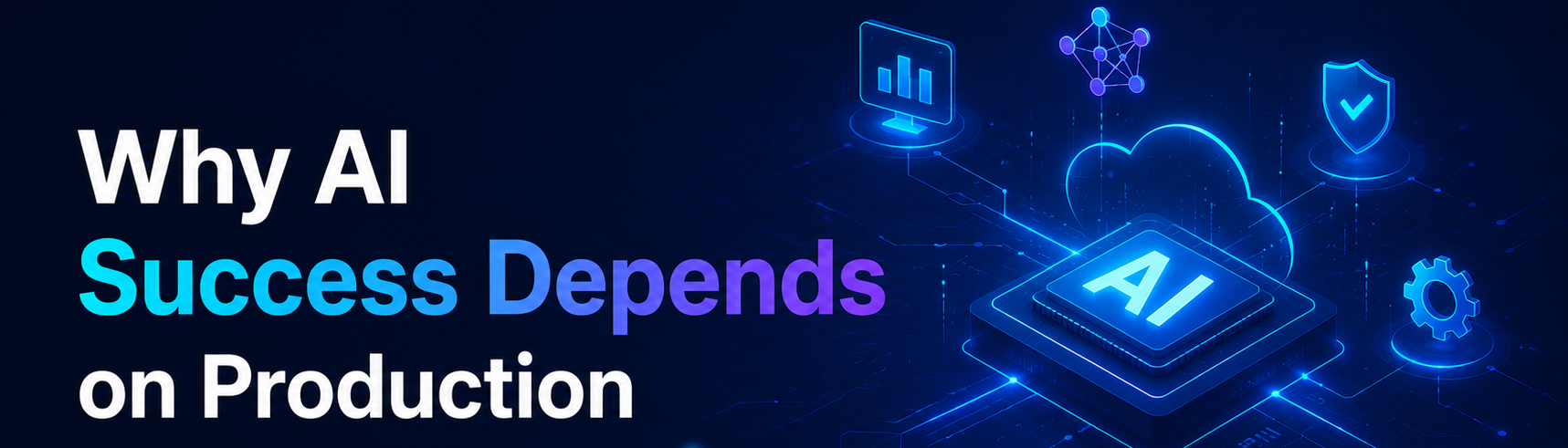
AI Features Do Not Fail in Research. They Fail in Production Engineering.
Every week, organizations announce new AI initiatives. Teams experiment with large language models, build impressive prototypes, and demonstrate promising use cases. In controlled environments, the results are often remarkable.
Yet, many AI features never make it into the hands of customers.
The reason isn't that the models don't work. It's that moving from a successful demo to a reliable product is far more challenging than building the AI itself.
The real bottleneck isn't research - it's production engineering.
The Prototype Is Only the Beginning
Building an AI proof of concept is relatively quick today. With powerful foundation models and readily available APIs, teams can create prototypes in days.
But taking that same feature into production is a different challenge altogether.
An AI capability must integrate seamlessly with existing products, scale reliably, protect sensitive data, manage latency, handle failures gracefully, and deliver consistent user experiences. It also needs monitoring, governance, testing, and continuous improvement. This is where many promising ideas stall.
Production Requires More Than Intelligence
An AI feature is only as valuable as its ability to perform reliably in the real world.
Production-ready AI requires organizations to solve challenges such as:
- Integrating AI into existing product workflows
- Ensuring security, privacy, and compliance
- Monitoring model performance over time
- Managing costs and infrastructure efficiently
- Handling unpredictable user inputs and edge cases
- Maintaining speed, reliability, and availability at scale
These aren't research problems - they're engineering problems.
Success Depends on the Entire System
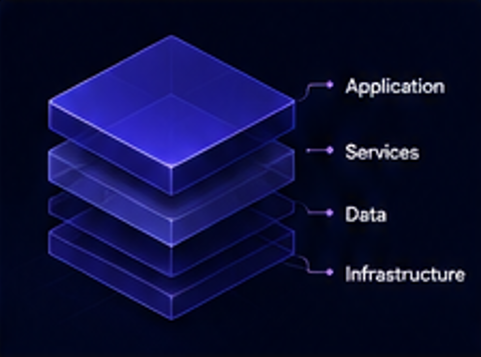
The best AI products don't succeed because they use the most advanced models. They succeed because the entire delivery system is designed to support AI in production. That means strong engineering practices, clear ownership, robust testing, observability, and cross-functional collaboration between product, engineering, security, and operations. The model may power the feature, but the engineering determines whether customers trust it.
The Competitive Advantage Is Execution
As AI models become increasingly accessible, the technology itself is becoming less of a differentiator. What separates successful organizations is their ability to consistently ship AI features that are secure, scalable, reliable, and easy to use. The winners won't necessarily be those with the most sophisticated models. They'll be the organizations that can operationalize AI faster than everyone else.
Build for Production from Day One
The question is no longer, "Can we build this with AI?"
It's "Can we deploy, operate, and improve it reliably at scale?"
Organizations that treat production engineering as an afterthought often find themselves stuck with impressive demos that never become valuable products. Those that design for production from the beginning move beyond experimentation. They turn AI from a promising technology into a dependable business capability. Because in the end, customers don't experience your prototype. They experience your production system.
Article by Silambarasan D




Apiary Technologies Pvt Ltd.
ASV Chandilya Towers, Evolve Spaces
Ground Floor, No. 5/397, Okkiyam
Thoraipakkam, Rajiv Gandhi Salai
OMR, Chennai 600096